
One of the most often asked questions we receive here at Raleigh Scuba Diving is “How long will the open water certification take?”. Like with most things in scuba diving, there are a couple of different answers with no real “right” one, but lots of different opinions. The answer depends on your personal preference, your experience and the dive shop’s business model sprinkled on top for good measure.
To be clear, our outlook on certifying students is we want to give you a great experience, make you an amazing diver but also insure you retain the knowledge we share to keep yourself and your family/friends safe when diving.
With that being said, let’s delve into how scuba classes are conducted, the agency “standards” instructors MUST adhere to, safety, student experience, and a few other things that we consider important to know BEFORE you choose your instructor or scuba shop for your training
For the purposes of understanding what standards are, agencies define specific aspects of dive training which must be adhered to by the instructor (aka – a standard). For example; under what conditions specific skills must be introduced. They’ve separated those out into two different types:
Now comes the specifics, and probably some confusion. When it comes to defining a “dive”, most agencies do NOT consider pool training a “dive” (for logging purposes). However most instructors keep it simple at call them “dives” because, honestly, what else would you call them. PADI defines a dive as reaching a minimum depth of 15 feet for 20 minutes OR at least 1400 PSI of your gas consumed in open water. Most other agencies are similar in their definition. For your Open Water certification, the dive requirement is:
There will be some variance in the agencies on the exact number dives required but most are fairly close to this requirement. You can do multiple training dives in a day (you can do ALL pool dives or up to 3 open water training dives in a single day). There are other restrictions but we won’t get too far into that. The important part to come away with for this is there are 8 (SDI) or 9 (PADI) full slates of skills that you must go thru for your in-water training (one slate per “dive”). In other words, there is a lot to cover.
Now we get to the fun part, how class is structured. Each agency has their own standards for when a diver can begin their open water training. For PADI, each student MUST have completed dives 1-2 in the pool and a certain amount of e-learning before going doing open water dive 1. You must complete pool dive 3 before your open water dive 2, etc… So does this sound confusing yet? The reason for this structure is the student must have seen a demonstration and practiced most skills in the pool BEFORE doing it in open water. There are a couple of exceptions (navigation, SMB inflation) but these rules are designed to teach students in a safe, controlled & relaxed manner.
These skills and practices MATTER!
Now that we’ve covered some of the elements you go through while learning to dive, we can better answer the question of how long should it actually take to get certified. If the open water class is structured in a particular way, it can be accomplished in as few as 2-3 days but most dive shops teach them over 4. The reason for this is simple, getting certified in 2 days is like cramming for a final exam. You may squeak by on the tests but you’ll retain very little knowledge and forget most of it in a short amount of time. As scuba diving is far more than an academic pursuit, Raleigh Scuba Diving feels cramming a certification into 2 or 3 days is an injustice to the diver, does not adhere to our core mission of training quality divers and can lead to knowledge gaps which are potentially hazardous for the student. Training over 4 days is actually more expensive for the shop and uses more resources, but this is not about our bottom line. It is about producing good quality, competent and safe divers who have the tools & knowledge to enjoy diving for a lifetime.
When we opened our dive shop, the founders agreed we will conduct our training dives not only to standards, but exceed those standards when it is beneficial. We don’t want sitting on a platform while you wait for other students to conduct skills to be your “dive”. We mandate actual dive time for each class so you can get real world practice and guidance from our instructors. Diving is truly a community of people and we are passionate about being good stewards of our community.

As with most organized sports, there is paperwork. While diving is a safe sport, there are certain medical conditions which can be exacerbated by diving. It’s important to note our instructors have cursory medical training. (as it pertains to diving) but we cannot make diagnosis or medical recommendations.
Therefore, every diver must answer a brief medical questionnaire & sign a waiver prior to beginning scuba lessons. Answering yes to a question on the medical form isn’t the end of the world, as many times the follow up questions will clear you for diving. At worst, you may require a physician sign off before you get into the water.
Every dive agency & instructor has a mandatory paperwork requirement to complete prior to the start of training.
Both forms shouldn’t take more than 10 minutes to complete.
If you have already obtained your e-learning through PADI or SDI, please contact us so we can provide you with a discount code.
Start by clicking the button below.

Scuba diving gives you the ability to visit a completely foreign world, and that world has a set of rules that is easy to understand, but does require some education. I like to compare it to driving. If you’ve never seen a car, a road, road signs or watched anyone drive, you wouldn’t last very long on the road.
The studying portion is often the easiest. but also the hardest step, at the same time. To begin your journey as a certified scuba diver, you’ll receive your your e-learning materials/code for the educational component. You can go thru this at your leisure but we do require you complete all materials prior to getting in the water.
Our instructors will verify you’ve completed your elearning, check your test scores and review anything you have questions about (or missed on the test) to insure you are ready for in-water training.
While everyone learns at their own pace, this is generally a 4-6 hour process.
At any point if you have questions, we are here to help.

Now we get to the fun stuff, the reason you signed up in the first place, we get to go underwater! Before we start your in-water training, we need to fit you with your personal scuba gear. This consists of your mask, fins and snorkel.
You can stop by our shop during business hours to get fitted OR contact us to setup a private fitting appointment.
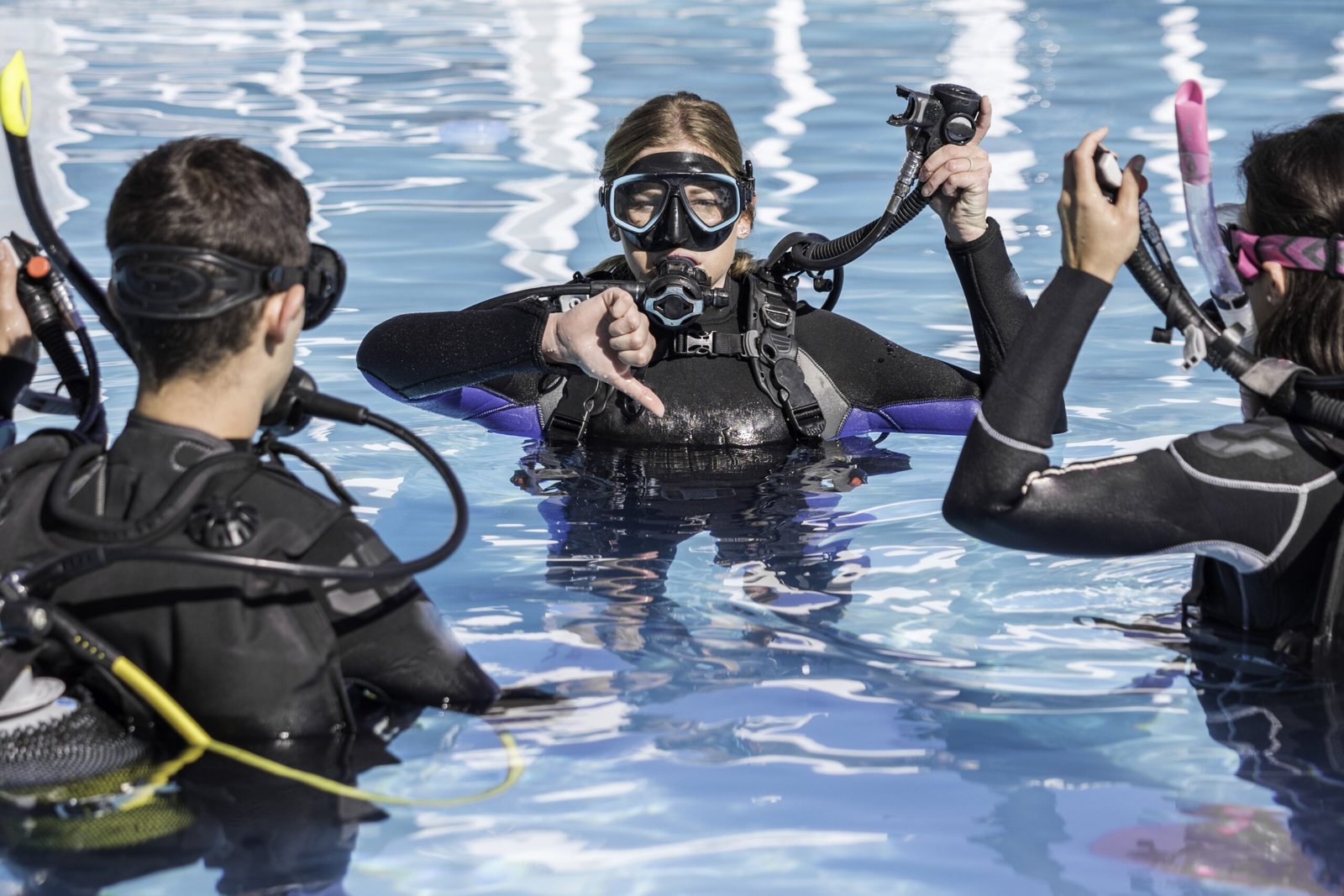
In-water training is done in 2 sections; pool & open water. You start your training in a shallow pool to learn basic scuba skills (breathing underwater, clearing your mask, clearing your regulator, etc). This is for safety so you can stand up at ANY point if you aren’t feeling it. Once you have mastered those skills, we move you into a deeper pool (10′) to work on skills like buoyancy, swimming, etc.
After you master your skills in the pool, we move to open water. This is done in the ocean during one of our charters or, most often, in one of our local quarries (Fantasy Lake or Mystery Lake). This is where you show off your skills to the instructor, and learn a couple more. It’s also where you get your first glimpse of being a true diver; hanging out with the fish and checking out a brand new world.
Pool sessions are 3-4 hours each (you have 2) and open water sessions are 4-5 hours (you have 2). We conduct training over a minimum of 4 days. Read more about how long your open water certification takes.